

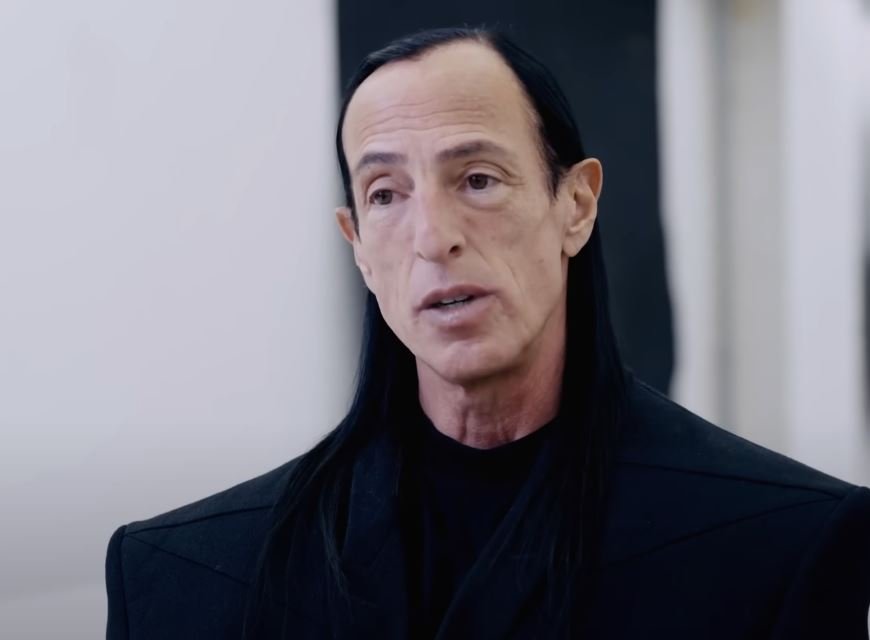
Like his creative legacy, Rick Owens’ wealth is difficult to categorize. While more ambitious projections say his net worth currently hovers around $300 million, other sources report it modestly at $2 million in 2024, while others claim $6 million in 2023. It is a remarkable variant that highlights the secrecy of independent labels as well as the extremely creative financial arrangements Owens and his longterm companion Michèle Lamy have established. Their own firm, Owenscorp, brought in over $140 million in 2023, but unlike brands that are acquired by luxury behemoths like LVMH or Kering, the house is still independent, making exact valuations difficult to determine.
Owens was born in 1961 in Porterville, California, into a devout, Catholic family, but he made a name for himself by defying expectations. He learned technical accuracy at Otis College and then Los Angeles Trade-Technical College, and his relocation to Los Angeles introduced him to the subcultures that would influence his style. His path was molded by his early encounters with Ed Templeton and then with Michèle Lamy, which enabled him to combine high couture grandeur with skate-punk gritty elements. These collaborations significantly enhance Owens’s creative process, creating a basis that upholds the distinctive voice of his company.
Rick Owens – Bio Data and Career Overview
| Attribute | Details |
|---|---|
| Full Name | Richard Saturnino Owens |
| Date of Birth | November 18, 1961 |
| Age | 63 (as of 2025) |
| Birthplace | Porterville, California, U.S. |
| Education | Otis College of Art and Design; Los Angeles Trade-Technical College |
| Occupation | Fashion Designer, Entrepreneur, Furniture Designer, Author |
| Spouse | Michèle Lamy (m. 2006) |
| Labels | Rick Owens, DRKSHDW, Rick Owens Lilies, HunRickOwens, Slab |
| Major Awards | CFDA Perry Ellis Award (2002), CFDA Lifetime Achievement Award (2017), Cooper-Hewitt Design Award, CFDA Menswear Designer of the Year (2019) |
| Reported Net Worth | Between $2M (2024), $6M (2023), and $300M (2024) depending on sources |
| Company | Owenscorp – Independent, privately held, generating >$140M in annual revenue |
The breakthrough came when Kate Moss was pictured wearing one of Owens’ leather coats for Vogue Paris, although his first boutique in Hollywood drew avant-garde customers. His debut runway was sponsored by Vogue America in 2002, and that one image catapulted him from cult obscurity into the wider industry spotlight. He and Lamy moved to Paris in 2003, setting up their atelier in a historic structure that had previously been connected to French politics. From there, he created especially avant-garde performances, whether they included models wearing striking monastic silhouettes or step teams stomping over runways. His reputation as a designer who reinvented not just clothing but the fashion show itself was strengthened by each exhibition.
His expansion has been incredibly successful financially. In addition to clothing, Owens expanded into furniture, books, and fragrances, developing a lifestyle brand that appeals to a wide range of markets. His minimalist yet gothic style is reflected in his furniture designs, which are sculptural, raw, and incredibly sturdy. His books capture his ideology, furthering his cultural impact, while his fragrance business turns his vision into aroma. He ensured that Owenscorp’s revenue remained extremely efficient even when clothes cycles slowed by diversifying, which strengthened the company’s resilience against the instability of luxury retail.
His reach was increased by celebrity influence. A$AP Rocky, Rihanna, and Kanye West transformed his voluminous shapes and recognizable “Ramones” sneakers into symbols of culture. His partnerships with Champion, Converse, and Birkenstock broadened his appeal and shown how adaptable his concept was, appealing to both popular customers and fashion insiders. Owens added his distinctive flair to each project, guaranteeing authenticity while expanding influence, in contrast to many designers who sacrifice their vision in large-scale partnerships.
Perspective can be gained by contrasting Owens’ financial situation with that of its industry peers. Giorgio Armani’s billion-dollar business is mostly based on licensing and cosmetics. Raf Simons drifted between homes without actually owning one, whereas Virgil Abloh, prior to his tragic demise, achieved the height of luxury with LVMH. But Owens took a different approach, staying independent, fostering cult loyalty, and declining to sell to corporations. He stands out as one of the rare designers whose success is fully entwined with his artistic integrity thanks to this approach, which is remarkably inexpensive in terms of risk but extremely costly in terms of emotional dedication.
Maintaining his creative and financial success has been largely dependent on his connection with Michèle Lamy. Owens used a striking image to describe their partnership: “a gypsy organizing a war with a fascist.” Her quirkiness balances the artistic and corporate realms by balancing his monastic discipline. Together, they molded Owenscorp into a highly profitable empire that maintains a strongly distinctive artistic character.
Owens’ influence goes beyond revenue alone. Long before the industry as a whole embraced diversity, his performances promoted inclusivity by showcasing sex workers, drag queens, and unusual models. His cultural influence extended beyond fashion, as seen by his retrospective exhibitions, such as “Subhuman Inhuman Superhuman” in Milan and “Temple of Love” in Paris. Style can be as much philosophy as it is business, as demonstrated by these contributions, which have greatly shortened the gap between art, fashion, and social criticism.
Therefore, the subject of Rick Owens’ net worth is more complex than merely math. Regardless of the amount—$2 million, $6 million, or $300 million—it hardly scratches the surface of his actual influence. His legacy lies in his capacity to challenge the very concept of beauty and style, to stay independent in an age of conglomerate control, and to turn subculture into luxury. His prosperity comes from more than just money; it also comes from his enduring impact, fortitude, and vision, which continue to motivate fans and designers of all generations.
Therefore, it would be more accurate to view Owens’ wealth as a dynamic narrative that shows his reluctance to follow the predetermined models of fashion rather than as a fixed figure. His career redefines success in the same way that his clothing redefines styles, demonstrating that in a field that relies heavily on innovation, independence can be both amazingly effective and remarkably lasting.
