Mothers as Architects: The Women Dismantling Centralized Schooling One Household at a Time
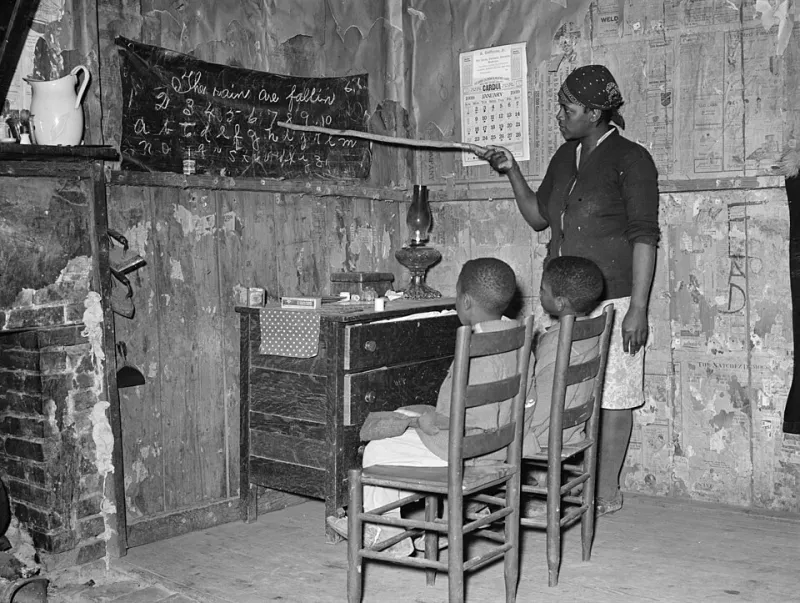
Photo: Russell Lee, Public domain, via Wikimedia Commons
There is a long tradition in American history of women who, confronted with institutions that failed their families, chose to build something better themselves. The mothers who established lending libraries in frontier towns. The women who organized one-room schoolhouses when no public provision existed. The educators and reformers who insisted, generation after generation, that the formation of young minds was too important to be surrendered entirely to the state.
That tradition is very much alive — and it is reshaping American education in ways that bureaucrats and curriculum committees are only beginning to comprehend.
The homeschooling movement, long caricatured as the province of religious separatists and social eccentrics, has undergone a remarkable transformation. It is now a broad, intellectually serious, and philosophically deliberate enterprise, driven in significant part by mothers who have concluded that the centralized schooling system cannot be trusted with the education — and, more importantly, the formation — of their children. According to the National Center for Education Statistics, the number of homeschooled students in the United States exceeded 3.3 million before the COVID-19 pandemic accelerated enrollment further. Post-pandemic surveys suggest that figure has grown substantially.
At the forefront of this movement, as has so often been true in American educational history, stand women.
What Centralized Education Actually Demands
To understand why so many mothers have chosen to exit the public school system, it is necessary to understand what that system now asks of families in exchange for its services.
Standardized education, as currently constituted in the United States, does not merely deliver academic content. It delivers a comprehensive worldview — one embedded in curriculum frameworks, assessment structures, library selections, counseling programs, and the daily culture of the school environment. Parents who object to elements of that worldview are typically offered two options: accept it, or pursue limited and often inadequate alternatives within the system itself.
For many women, neither option is acceptable. They are not opposed to education. They are opposed to the specific ideology, pedagogical philosophy, and institutional priorities that have come to define public schooling in a significant portion of the country. And they have concluded — rationally and deliberately — that the most effective response is not to petition the school board, but to withdraw entirely and build something superior.
This is not a passive choice. It is an act of profound educational and philosophical self-determination.
The Homeschooling Mother as Civic Actor
It would be a mistake to view the women leading this movement solely through the lens of maternal protectiveness, though that instinct is entirely legitimate. Many of them are also motivated by something that looks very much like civic conviction.
The American founding tradition placed enormous weight on an educated citizenry — not merely a credentialed one, but one capable of genuine critical reasoning, historical literacy, and engagement with first principles. The women who are homeschooling their children today frequently cite this tradition explicitly. They are not withdrawing from civic life. They are attempting to restore, within their own households, the kind of education that produces citizens rather than consumers of institutional narratives.
Classical education models, which have experienced a dramatic revival within the homeschooling community, draw directly on this tradition. The trivium — grammar, logic, rhetoric — trains students not in what to think, but in how to think. It is, by design, the opposite of the standardized test-preparation model that dominates contemporary public schooling. For mothers who believe that intellectual independence is both a personal virtue and a civic necessity, the appeal is obvious.
Faith-based homeschooling communities, meanwhile, are recovering educational lineages that stretch back centuries — to the conviction that the formation of moral character and the transmission of religious heritage are inseparable from academic instruction. These mothers are not merely teaching their children to read and calculate. They are passing on a civilization.
The Practical Architecture of a Home Education
Homeschooling is not, it should be said plainly, a simple undertaking. The women who pursue it are making a substantial commitment of time, energy, and intellectual effort. Many reduce or eliminate paid employment to do so. Others structure their professional lives — often through the kind of independent and flexible work arrangements discussed elsewhere in these pages — to accommodate the demands of full-time home education.
The resources available to them, however, have never been more extensive. Curriculum providers ranging from rigorous classical academies to STEM-focused programs to faith-integrated coursework have built robust offerings specifically designed for home educators. Co-operative learning groups allow homeschooling families to pool instructional expertise, providing children with peer interaction and specialized instruction that no single household could replicate alone. Online platforms have extended the reach of expert instruction into homes across the country, including those in rural areas that would otherwise have limited access to advanced coursework.
State legal frameworks for homeschooling vary considerably — from the relatively permissive to the more heavily regulated — and navigating them requires awareness and, in some cases, advocacy. Organizations such as the Home School Legal Defense Association have played a critical role in protecting the legal rights of home-educating families and expanding the freedoms available to them. The women who lead and populate these advocacy networks are, in their own way, continuing the tradition of civic engagement that has always characterized American mothers at their most purposeful.
A Heritage Worth Defending
The history of American education is not, as its current institutional custodians sometimes imply, a straightforward march toward the centralized, standardized model that now predominates. For most of the republic's history, education was a decentralized, community-based, and often family-directed enterprise. The one-room schoolhouse was governed by local parents and trustees. The curriculum reflected the values of the community it served. The teacher was accountable to families, not to a distant administrative apparatus.
The consolidation and centralization of American schooling is a relatively recent development — and one whose consequences are now being weighed by millions of families who find the result wanting.
The women who are homeschooling their children are not rejecting education. They are rejecting a specific institutional arrangement that they have determined does not serve their children, their families, or their deepest convictions. In doing so, they are acting in a tradition as old as the republic itself: the tradition of American women who looked at what existed, found it insufficient, and built something better.
That tradition is among the most authentically American things there is. And it is, at this moment, very much alive.