

In addition to setting a Senate record, Senator Cory Booker’s defiant 25-hour speech sparked a reinvigorated national conversation about truth, censorship, and the responsibility of leadership in turbulent times. His speech, which was delivered with firm conviction and incredibly good timing, questioned not only policy but also the fundamental ideas of free speech.
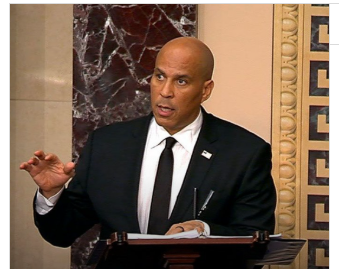
A Monday night, just after 7 p.m., Booker made the commitment to stand “as long as physically possible.” By the next evening, the room was filled with hushed amazement that was only sometimes interrupted by applause, tears, and coworkers’ voices of solidarity. The speech was not only lengthy but also incredibly clear, emotionally charged, and meticulously detailed.
Key Information – Senator Cory Booker’s Speech and Impact
| Attribute | Detail |
|---|---|
| Full Name | Cory Anthony Booker |
| Date of Birth | April 27, 1969 |
| Political Affiliation | Democratic Party |
| Current Role | U.S. Senator, New Jersey |
| Date of Speech | March 10–11, 2025 |
| Speech Duration | 25 hours, 4 minutes |
| Historic Milestone | Longest Senate speech ever recorded |
| Main Focus Areas | Free speech, immigration, healthcare, economy, education |
| Digital Engagement | 350M TikTok likes, 115K+ YouTube live viewers |
| Reference Link |
Booker’s laser-sharp attention helped him navigate past problems. A particularly creative lens was used to examine immigration raids, growing housing costs, student loan debt, and the pervasive influence of misinformation. His speech remained incredibly pertinent, with each word crafted to match the gravity of the moment, in contrast to previous Senate marathons that were filled with children’s rhymes or phone books.
The speech drew on personal sacrifice and was strikingly comparable to civil rights protests in previous decades. Booker had abstained from all fluids, fasted for days, and prioritized mental toughness over comfort. By doing this, he symbolically allied himself with people whose voices are frequently left out of the national conversation, particularly young voters, low-income workers, and immigrants who are trapped in censoring algorithms.
Even seasoned parliamentarians have been disturbed by the rise in digital manipulation in recent days. Algorithmic censorship, deepfakes, and AI-driven disinformation operations are no longer passive dangers; rather, they are proactive factors eroding confidence. Booker’s allusions to these technological risks were supported by current statistics and firsthand reports that vividly depicted the harm already done, so they weren’t only conjecture.
Booker humanized the effects of speech suppression by using actual letters from citizens, such as one from a nurse who was refused access to reasonably priced insulin and another from a veteran whose protest content was shadowbanned. Despite being policy-focused, his story was intensely personal. This combination produced a cadence that connected institutional halls with virtual public squares, moving from the Senate floor to social media feeds.
We witnessed directly how crucial honest communication became throughout the outbreak. Booker invoked those recollections to illustrate how a fragmented information environment jeopardizes lives as well as ideas. He cautioned that “we are left vulnerable to those who thrive in darkness if we cannot speak truth across digital landscapes.”
Booker’s voice grew softer but still firm as he approached the fifteenth hour. He acknowledged that “we’re behind where we hoped,” but he wouldn’t give up. As the speech came to a close, the level of participation significantly increased, with celebrities such as John Legend and Kerry Washington uploading footage and inspiring young people to support the concept of civic resistance. It turned into a pop culture event rather than merely a Senate moment.
Near the 24-hour mark, Chuck Schumer, who was intently observing, interrupted—not to stop the speech, but to praise it. A standing ovation was given when he said, “Do you realize how proud America is of you?” Booker grasped his chest, clearly upset. It was a dramatic but genuine moment that demonstrated how vulnerability in speaking frequently precedes bravery in policy.
Booker strategically compared his speech to that of Strom Thurmond, who attempted to thwart civil rights legislation in 1957 with his historic filibuster. It was a striking and enlightening contrast. Booker represented access where Thurmond represented exclusivity. One spent his time opposing equality, while the other spent it promoting it. The message was particularly evident for younger people who were not aware with that history thanks to explainers and viral threads that broke down the symbolic reversal.
By the last hour, Booker had addressed school reform, reproductive rights, and foreign policy—not holding back but providing remarkably optimistic possibilities. “If we first rebuild trust in the old framework, we can build a new one,” he stated. His suggestions weren’t ambiguous. Stronger AI regulation to protect journalistic integrity, governmental subsidies for independent media, and a digital bill of rights were among them.
These recommendations are significant in light of the expanding tech monopolies. Elon Musk, who is currently serving as a controversial senior advisor to the White House, said nothing, but his digital influence was very noticeable. Musk’s platform choices, especially those pertaining to algorithmic screening of political information, were gently but vehemently condemned by Booker in his address. Today, it is extremely difficult to distinguish between private tech decisions and public policy, and Booker deftly demonstrated how doing so can be especially detrimental to democracy.
He concluded with a nod to John Lewis after twenty-five hours, saying, “Let’s get in good trouble.” It was a call to action rather than a cliche. When silence turned into treachery, Lewis thought it was best to make noise. That’s exactly what Booker did, standing emotionally raw and dehydrated.
His message spread incredibly quickly thanks to viral outreach and savvy alliances. The speech was analyzed on more than 100 podcast episodes, shortened into 70-second reels, and created into TikTok slideshows within 12 hours after its conclusion. Whether grudgingly or not, pundits from both political parties acknowledged that something important had occurred.
That night, Booker made no demands for votes or legislation. He urged a nation weary of distorted realities to demand more from its institutions, clarity, and bravery. In doing so, he served as a reminder to Americans that censorship does not always manifest itself in court decisions or black uniforms. It can occasionally infiltrate computer backdoors and subtly alter our perceptions of reality.
