

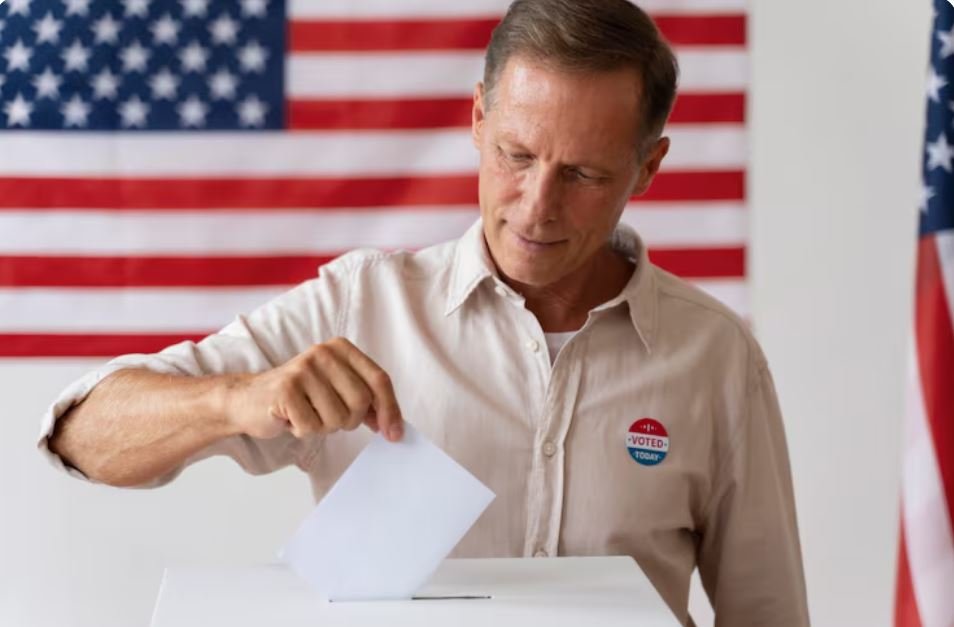
Even after being thoroughly refuted, claims of voter fraud persist. Like an ancient superstition, they endure because of their exceptional value to politicians, media personalities, and even disgruntled voters who are looking for answers, not because of supporting data. Similar to how celebrity scandals persist long after courts and facts have cleared the record, the narrative keeps coming up despite repeated official confirmations that American elections are still safe.
Politicians use these assertions as a tactic. Donald Trump used the term “rigged election” as a weapon and a shield, transforming it into a political identity. After losing in 2020, he energized supporters and sowed the seeds of distrust by using fraud rhetoric to justify his defeat. Curiously, the story vanished in 2024 when his fortunes turned around and was replaced by laudation for the election officials he had previously disparaged. The same language was used by Kamala Harris’s 2024 supporters, who suggested hacking or manipulation instead of acknowledging their candidate’s defeat. A truth is revealed by the symmetry between the two camps: fraud claims are more motivated by convenience than by fact.
| Key Factor | Explanation |
|---|---|
| Political Leverage | Allegations keep losing candidates relevant and energize supporters. |
| Psychological Comfort | Easier to believe fraud than accept a painful defeat. |
| Social Media Power | Falsehoods spread faster than corrections, shaping beliefs. |
| AI & Disinformation | Fabricated videos and foreign manipulation intensify doubt. |
| Decentralized Elections | Patchwork of state systems fuels confusion and suspicion. |
| Slow Counts | Delays in mail ballot reporting spark rumors of theft. |
| Institutional Distrust | Declining faith in officials makes fraud claims believable. |
| Legal Loopholes | Dozens of failed lawsuits still keep false claims alive. |
| Celebrity & Media Role | Influencers, pundits, and politicians amplify the narrative. |
The role of psychology is equally compelling. Believing that ballots were stolen is a remarkably effective way for many partisans to ease the pain of losing. Imagining villains controlling machines is less emotionally taxing than acknowledging that millions of neighbors genuinely sided with the opposition. Political scientists have extensively studied this type of motivated reasoning, which demonstrates how voters manipulate the truth to suit their allegiance. Humility is necessary to accept a loss; suspicion is all that is needed to believe in theft.
The cycle is exacerbated by social media. Allegations are disseminated more quickly on websites like Facebook and X, frequently thanks to footage of voting procedures going awry or machines breaking down. Reframed as deliberate fraud, what starts as a technical glitch in a Pennsylvania county turns into a viral video that has been viewed by millions. Studies consistently demonstrate that because lies are dramatic, sensational, and easily assimilated, they spread much more quickly than corrections. Furthermore, the difficulty for those disseminating false information has significantly improved, leaving fact-checkers permanently behind, as AI tools are now able to produce convincing fake footage.
The instability is exacerbated by outside influences. Foreign disinformation actors have returned in more advanced forms, sowing doubts that Americans then magnify, much like Russia did in 2016 by taking advantage of divisions. Influencers and even television pundits who capitalize on outrage can spread a single fake post throughout partisan echo chambers. The continual reinforcement turns skepticism into certainty, much like gossip that is played repeatedly.
The fire is further fueled by institutional factors. Once hailed as a defense against hacking, the decentralized nature of American elections leads to disparities among thousands of jurisdictions. Even if a machine error in Arizona or a ballot mishap in Wisconsin is quickly fixed, it can have a nationwide impact. In a similar vein, the tardiness of mail-in ballot counting has frequently been cited as proof of fraud. The 2020 cycle demonstrated how “stop the count” chants, which were misrepresented as evil manipulation, originated from routine delays.
The problem is made worse by the decline in institutional trust. Trust in the media, courts, and Congress has gradually eroded over decades. Many Americans perceive mistakes as deliberate corruption rather than human error, resulting in a marked decline in trust. Particularly at risk are independent voters, who frequently make the difference in close elections; polls indicate that they are less likely to cast ballots when they feel that elections are being rigged. In this way, false information is very effective at changing participation as well as perceptions.
Even though courts have rejected fraud claims on numerous occasions, the myth persists. Lawsuits contesting outcomes, including those supervised by judges chosen by the politicians making the accusations, fell apart under scrutiny in 2020 and 2024. Nevertheless, the spectacle of legal challenges generates news stories that support conspiracies. Since there are no serious consequences for disseminating false information, the cycle continues, with lawsuits acting more as political theater than as actual legal action.
Media personalities, public figures, and celebrities are also very important. Large-follower politicians exaggerate unfounded allegations, and influencers repurpose them for financial gain. Even late-night comedians like Jimmy Kimmel unintentionally increase the narrative’s visibility by making fun of the contradictions. Like celebrity scandals, fraud claims endure because they are amusing, polarizing, and highly marketable rather than because they are true.
There are significant cultural repercussions. Fraud allegations are cultural markers that drive a wedge between friendships, families, and workplaces rather than being isolated talking points. The fact that many Americans would now refrain from dating someone from the opposing party, according to polling, highlights how profoundly these accusations affect identity. Exaggerated fears of vote theft are the fuel for fraud narratives, which give people easy villains in complicated times, much like McCarthyism did.
These claims are unlikely to disappear, as evidenced by their persistence. They are profitable, psychologically reassuring, and politically beneficial. They polarize, entertain, and mobilize in ways that simultaneously serve several interests. Their persistence illustrates how myths, once established, turn out to be remarkably resilient—they outlast facts, decisions, and government declarations.
