

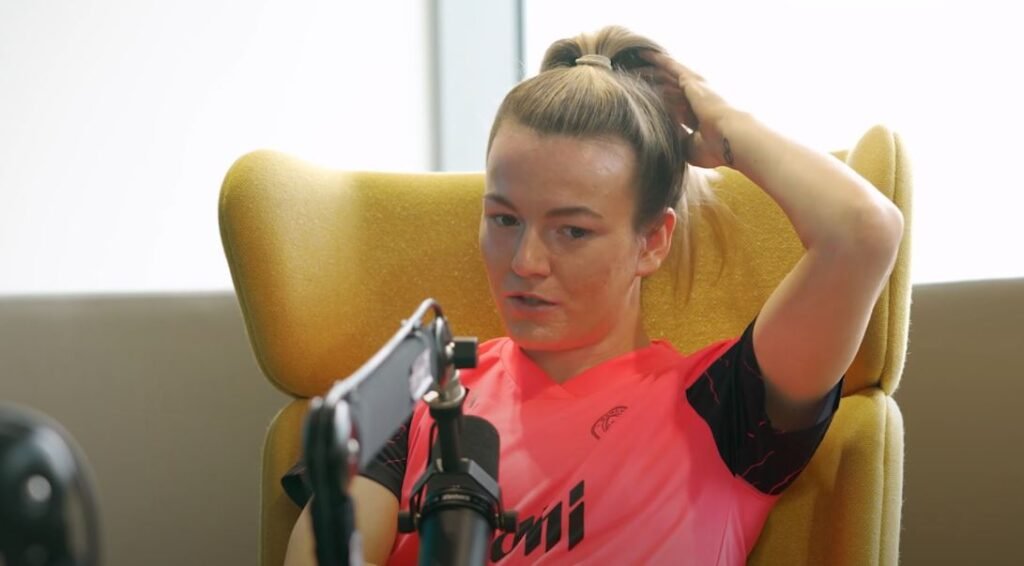
Lauren Hemp’s pay has emerged as a benchmark for the growing economics of women’s football. With an annual salary of approximately £400,000 from her Manchester City contract, she comfortably occupies the top tier of the Women’s Super League. Although neither the club nor the player have formally revealed the number, it has been widely reported and is considered a standard measure of her worth. Her overall income increases further when combined with her endorsement deals from Nike, Lego, and Visa, which reflects a larger change in the way the sport views its female stars.
This financial shift effectively highlights the development of women’s football. Leading England players were still making about £20,000 a year just over ten years ago, and they frequently needed part-time work to make ends meet. Hemp and her peers now work in a much better climate where six-figure contracts are the norm rather than the exception. Her pay is especially creative in demonstrating that women’s football is not only marketable but also commercially sustainable, even though it is still far less than what men in the Premier League make.
| Category | Details |
|---|---|
| Full Name | Lauren May Hemp |
| Date of Birth | August 7, 2000 |
| Birthplace | North Walsham, Norfolk, England |
| Nationality | English |
| Position | Winger / Forward |
| Current Club | Manchester City Women (WSL) |
| Estimated Club Salary | Around £400,000 per year (widely reported, not officially confirmed) |
| Sponsorship Partners | Nike, Lego, EA Sports, Visa, Starling Bank |
| Estimated Net Worth | Around $2 million (2025) |
| National Team | England Lionesses |
| Major Honours | UEFA Women’s Euro 2022 Winner, MBE in 2024 for services to football |
Hemp’s 2022 contract extension with Manchester City was especially advantageous. She had already won four PFA Young Player of the Year titles by that point, solidifying her position as a key player in City’s strategic plans. With a pay raise that put her on par with Sam Kerr and Alessia Russo, the new contract, which runs through 2027, essentially rewarded her loyalty. For comparison, Russo reportedly commands a deal worth over £500,000 at Arsenal, while Kerr reportedly earns £449,000 at Chelsea. Hemp is a player whose contributions are impossible to ignore, and her estimated £400,000 puts her in this elite trio.
The timing of Hemp’s earnings story is what makes it so similar to Russo’s. Both benefited from Euro 2022, when England’s Lionesses captivated supporters and ignited a sponsorship craze. Nike swiftly incorporated Hemp into their campaigns honoring women’s football because of her reputation as a creative, fast-paced winger. Her love of creating elaborate Lego sets is a highly adaptable marketing narrative that combines her relatable personality with a well-known brand, so Lego also took advantage of her off-field interests.
Sponsorships offer a substantial financial buffer. According to analysts, Hemp’s off-pitch transactions bring in an extra £300,000 to £500,000 a year. These collaborations demonstrate how athletes are becoming more than just players—they are cultural icons. Hemp is able to strike a balance between accessibility and mystique thanks to her introverted personality and daring on-field performances. Brands find this balance to be particularly evident in their messaging. Hemp is an example of a new generation of football stars who are fusing their athletic identities with lifestyle branding, much like Serena Williams became synonymous with Nike campaigns.
Her increasing financial stability reflects a societal rebalancing as well as a personal one. Once marginalized, women’s football now enjoys unprecedented levels of media attention, corporate sponsorships, and broadcast rights. Even though Hemp’s salary is small in comparison to Manchester City’s Kevin De Bruyne’s weekly salary, it is growing much more quickly than many anticipated. Despite the disparity in numbers, the comparison represents a growing divide in regard, investment, and focus.
The impact of Lauren Hemp extends to international duty, where FA bonuses and prize money supplement earnings. It was anticipated that players would receive bonuses of over £70,000 each following England’s victory at Euro 2025. These accomplishments serve to further solidify Hemp’s reputation, and her growing Instagram following enables her to access the lucrative realm of social media collaborations. Today, the weekly salary of a mid-table WSL player can be equaled by a Lioness’s single sponsored post, and Hemp’s quiet charm guarantees that her brand stays both realistic and aspirational.
North Walsham, her hometown, has proudly welcomed her ascent. Her accomplishments are honored in a 2023 mural that serves as a reminder of how one person’s success can motivate a community. Hemp is a living example of how professional football can offer young girls in Norfolk not only prestige but also real financial security. This cultural symbolism is especially helpful in changing how people view sports as a potential career path for women. Sustainable livelihoods are more important than just trophies.
Her public persona is further layered by her private life. Despite her reputation for being quiet, she frequently stays out of the spotlight outside of football in favor of pastimes like building Lego models. In contrast to the polished, frequently untouchable personas of many male athletes, this personal authenticity humanizes her and increases her relatability, and it is surprisingly inexpensive for brands. Her longevity in commercial settings is improved by this relatability, which guarantees that she will continue to be marketable even as her playing career develops.
Hemp’s strategy is also characterized by financial prudence. According to reports, LM Hemp Ltd. has over £370,000 in assets, demonstrating her readiness for the future. Given that women’s football careers are often shorter and less financially secure, her approach is especially creative and serves as a powerful model for other players. Her emphasis on obtaining long-term stability shows maturity beyond her years and guarantees that she will continue to have an impact after her playing career is over.
Hemp’s pay is consistent with historical precedents in the larger framework of gender equality. Football players today are calling for more equitable contracts and visibility, echoing Billie Jean King’s struggle for tennis equality. Through her income, Hemp joins a tradition of athletes who are transforming their sports in both an economic and cultural sense. By making six figures a year, she is not only compensated for her abilities but also acknowledged for the social change her generation is bringing about.
