

Despite winning awards and changing the course of history, England’s Lionesses are still caught up in a system that doesn’t fairly recognize their achievements. It was celebrated as a breakthrough when the equal-pay milestone was achieved in 2020, standardizing match fees for men and women at £2,000 per game. However, the excitement is significantly tempered by the ongoing disparity in club pay, sponsorship revenue, and performance bonuses that lies behind that headline.
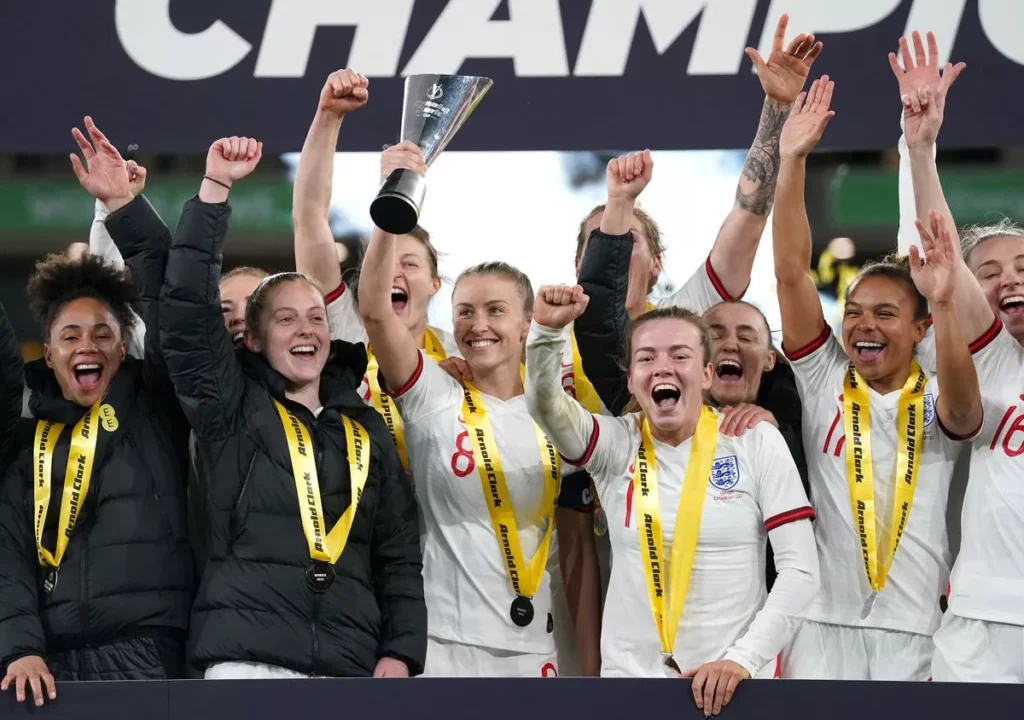
Each Lioness receives a bonus of £55,000 during the 2022 Euros. In comparison, male athletes who made it to the 2020 final but lost were awarded £300,000. This glaring disparity, denounced by Women in Sport, illustrates how football’s monetary worth is still not commensurate with its impact or merit. Interestingly, the Lionesses only received a small portion of what their male colleagues received for placing second, even though they dominated Europe. The FA raised the 2025 bonus pool to £1.7 million as the story progressed. Each player will receive almost £73,000 if England wins, which is an increase of £18,000 over the previous three years.
Lionesses Salary: Key Figures and Comparisons
| Category | Details |
|---|---|
| England Match Fee (Men & Women) | £2,000 per match (equal since 2020) |
| Women’s Euro 2022 Bonus (Per Player) | £55,000 |
| Men’s Euro 2020 Bonus (Per Player) | £300,000 |
| Lionesses Euro 2025 Bonus (Avg. if they win) | £73,000 from £1.7 million FA bonus pool |
| WSL Average Annual Salary | £47,000 |
| Leah Williamson (Highest WSL earner, approx.) | £200,000 |
| Harry Kane (Bayern Munich, England captain) | £200,000 per week |
| Keira Walsh (Barcelona, top-paid Englishwoman) | £380,000 per year |
| UEFA Euro 2025 Women’s Prize Pool | €41 million (156% increase from 2022) |
| UEFA Euro 2024 Men’s Prize Pool | €331 million |
| Verified Source |
This minor but significant change has been seen as a very positive indication in recent months. The underlying disparities that exist within club compensation are still present, though. Even though the Women’s Super League has expanded significantly, the financial gains are still small. Players often make £47,000 a year. According to reports, elite athletes like Leah Williamson, who captains both Arsenal and England, receive £200,000 annually, which some male athletes make in less than a week.
For comparison, England’s men’s captain, Harry Kane, makes that much every seven days while playing for Bayern Munich. Despite being frightening, this comparison highlights the stark disparity in the financial environment of football. It is more challenging to defend the ongoing inequality when it is framed via people who govern their countries with similar commitment.
The problem is made even more apparent when looking at data from around the world. FIFA’s 2024 “Setting the Pace” benchmarking study states that the typical female football player makes only £8,400 annually. Only 16 clubs worldwide pay women more than £37,000 a year, compared to the average salary of roughly £17,860 for Tier 1 clubs, or those in wealthier divisions. Players outside of this bubble frequently make less than £2,100, which forces many to work two jobs. Many athletes are unable to devote themselves entirely to their careers as a result of this drastically diminished emphasis on financial support, which eventually limits their potential.
UEFA made a calculated effort to strike a balance by requiring that players get 30–40% of the €41 million prize fund for Euro 2025. Echoing FIFA’s decision before to the 2023 Women’s World Cup, it’s a positive step. When compared to the €331 million prize pool for the men’s event, this amount is still a tiny portion. If they won, Spain’s men’s squad would receive €28.25 million, which is more than six times the amount their female colleagues could receive.
Conflicts over performance bonuses spiked during the run-up to the 2023 Women’s World Cup. Thankfully, the FA agreed to allocate the £1.75 million bonus fund fairly, so these problems did not overshadow preparations for Euro 2025. This proactive step was quite successful in promoting team cohesion and preventing distractions off the field. But the overall financial picture is still disjointed and inequitable.
There is growing opposition to the idea that compensation should be based on popularity or ticket sales. When Arsenal Women played in the Champions League semifinal in May 2023, Emirates Stadium nearly sold out with an incredible 60,063 spectators. It wasn’t an isolated incident. Since 2017, the number of people watching women’s football has increased by more than 130%. 37.6 million spectators watched the 2022 Euros final, confirming the game’s financial viability.
Strong media relationships, such as the £8 million-per-season agreement with the BBC and Sky, are helping the women’s game gradually evolve into a highly effective business machine. These actions have created new cash streams, greatly increased visibility, and—above all—changed public opinion. However, participants continue to receive unequal financial gains.
Keira Walsh, who currently plays for FC Barcelona, makes £380,000 annually, making her the highest-paid Englishwoman in football. It’s interesting to note that all nine of the highest-paid players currently compete outside of the United Kingdom. This tendency draws attention to a crucial economic fact: many top English players must turn elsewhere in order to make respectable earnings. Although this presents opportunity, it also highlights how little domestic support there is for women’s football.
History was against them for decades. Due to antiquated ideas of decorum, the Football Association banned women from playing in 1921, which caused the sport to lag for more than 50 years. The consequences of that long-term neglect persist even though it was lifted in 1971. Only 12 countries participated in the first Women’s World Cup, which was held on turf rather than grass and lasted 80 minutes, in 1991. Amazingly, more than half a million people attended the event.
In 2015, 1.3 million people watched Canada’s World Cup. Nevertheless, it fell well short of the 2.5 million people who went to the men’s tournament in Italy in 1990 and the 3.5 million who went to Brazil in 2014. The reality that women’s football has experienced exponential development with significantly fewer resources is overlooked by these comparisons, which are frequently used to defend lower remuneration.
Champions of equity, such as tennis player Billie Jean King, have demonstrated in recent years that structural change is not only feasible but also profitable. Professional tennis was changed by her struggle for equitable Grand Slam prize money. Football is starting to undergo a similar change, but it’s still in its infancy. The current rate of progress is encouraging but not enough.
The Lionesses are more than just role models for girls who watch from stadium stands to grassroots academies; they are revolutionaries. Their tale is one of perseverance as much as ambition or fame. The once-unavoidable economic disparity is now being openly contested. Even while there are still compensation disparities, particularly at the club level, things are trending in the direction of equity.
